Key takeaway
Review the core requirements of the career guide, identify key action steps, and execute them consistently to build long-term momentum.
Common mistakes to avoid
- Expecting instant results from a single application or outreach message.
- Neglecting basic layout standards and formatting checklist rules.
- Failing to track details and dates, leading to missed deadlines.
Step-by-step preparation
Analyze your current status and list areas that require improvement.
Break down target tasks into small, weekly actionable chunks.
Perform weekly reviews to correct course and stay consistent.
Your checklist
The Pattern-Based Mastery Philosophy: Moving Beyond Blind Grinding
The biggest trap in DSA preparation is measuring progress by the raw number of problems solved rather than the depth of pattern recognition. When an engineering candidate approaches coding questions as discrete memorization tasks, any minor change in problem constraints—such as allowing negative numbers, requiring in-place modification, or introducing duplicate elements—causes complete disorientation.
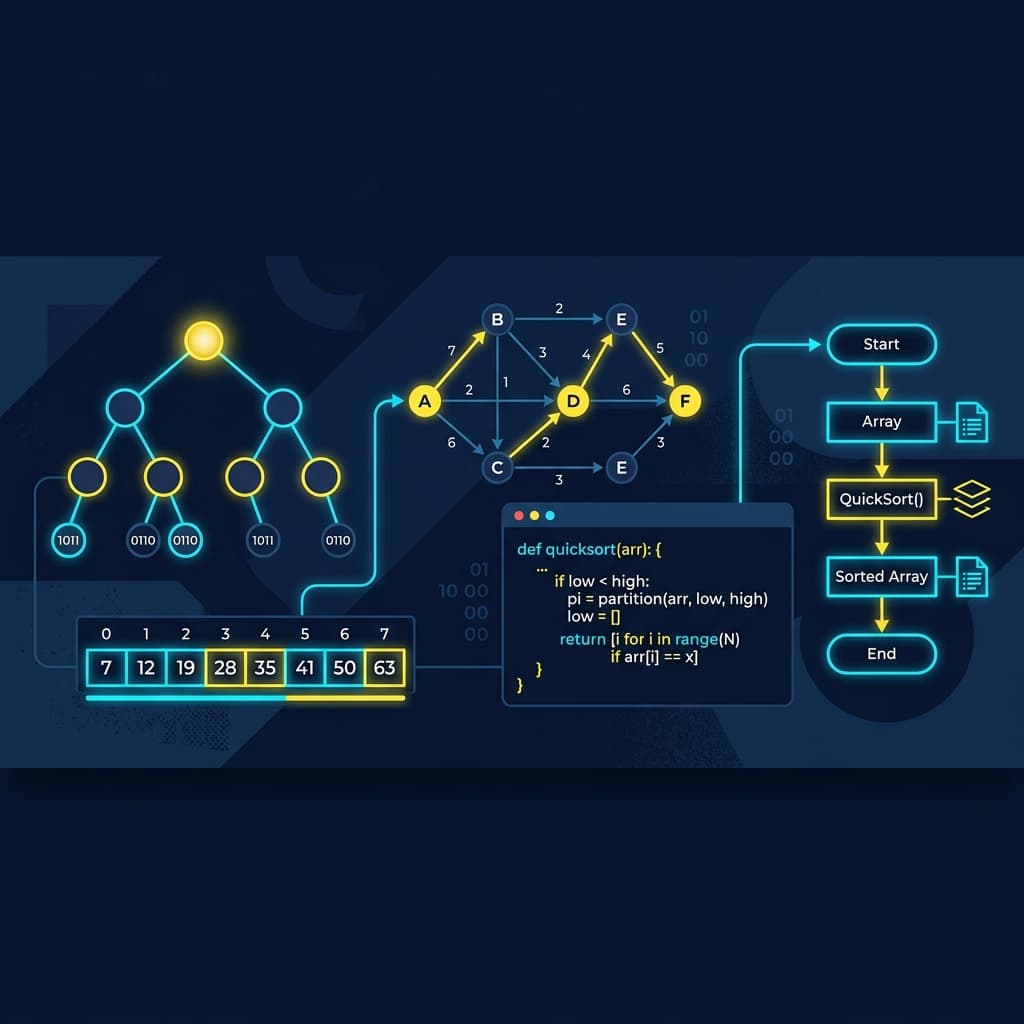
Pattern-based learning operates on a mental taxonomy. Every coding problem is essentially an input data structure transformed by an algorithmic strategy to satisfy an objective function under given constraints. When you see a problem asking for contiguous subarray properties, your mind should immediately evaluate Prefix Sums, Sliding Window, and Kadane's algorithm. When you see a problem asking for pairs in a sorted collection, Two Pointers should be your immediate hypothesis.
By mastering 12 core algorithmic patterns, you build a mental decision tree that allows you to classify new, unseen problems in under two minutes during live interviews. This structural clarity eliminates panic, reduces cognitive load, and frees up mental energy to focus on clean syntax and boundary conditions.
- Audit your current DSA practice by patterns rather than raw problem count
- Create a dedicated pattern notebook documenting template code and invariant properties
- Practice explaining why a specific pattern applies before writing any code
- Review pattern archetypes weekly to maintain rapid identification reflexes
Core Linear and Non-Linear Data Structures: Foundational Archetypes
A robust DSA foundation begins with deep fluency in core data structures and their memory layouts. In technical interviews, interviewers frequently evaluate whether you understand how data is stored in memory and how different operations affect cache locality and algorithmic complexity.
Arrays and Strings: Master in-place array manipulation without allocating extra memory. Core archetypes include the Two Pointers technique (one pointer at the start and one at the end for sorted collections, or slow/fast runner pointers for in-place deduplication) and the Sliding Window pattern (expanding a right pointer to satisfy a condition, then contracting a left pointer to optimize window size). Ensure you understand prefix sums and hash-map frequency counting for O(N) subarray sum lookups.
Linked Lists and Stacks: For linked lists, master pointer manipulation without creating new nodes. Learn Floyd's Cycle Detection algorithm (tortoise and hare) and sublist reversal algorithms. For stacks, master the Monotonic Stack pattern—maintaining elements in strictly increasing or decreasing order. Monotonic stacks solve Next Greater Element, Daily Temperatures, and Largest Rectangle in Histogram in optimal O(N) time instead of brute-force O(N^2).
Trees and Binary Search Trees (BST): Trees represent hierarchical branching. You must be able to write recursive Depth-First Search (Preorder, Inorder, Postorder) and iterative Breadth-First Search (Level-Order Traversal using a Queue) without hesitation. Understand the Lowest Common Ancestor (LCA) algorithm in both regular binary trees and BSTs, tree diameter calculations, and serialization/deserialization techniques.
Graphs: Graph questions evaluate relational modeling. Represent graphs using adjacency lists. Master Breadth-First Search (BFS) for unweighted shortest paths and Depth-First Search (DFS) for connected components and cycle detection. Learn Kahn's Algorithm (indegree-based BFS) and DFS with state coloring (Unvisited, Visiting, Visited) for Topological Sorting in Directed Acyclic Graphs (DAGs). For weighted shortest paths, understand Dijkstra's algorithm with a Min-Heap priority queue.
Illustrative Mental Model (Visualizing Graph Cycle Detection with State Coloring): In directed graph cycle detection, a standard boolean "visited" array is insufficient because reaching an already-visited node from a different parent branch does not necessarily indicate a cycle. A clear visual approach uses 3-state coloring: White (unvisited), Gray (currently visiting on active recursion stack), and Black (completely explored). If a DFS traversal from an active Gray node encounters an adjacent node that is also Gray, a back-edge exists, proving a cycle. Once all descendants of a node are traversed, its color transitions to Black. Visualizing active recursion frames as Gray states simplifies DAG cycle detection algorithms.
- Implement singly linked list reversal iteratively and recursively from memory
- Implement Level-Order Tree Traversal using an explicit queue data structure
- Implement Kahn's Topological Sort using an in-degree array and queue
- Write a Monotonic Stack template for Next Greater Element in O(N) time
Advanced Algorithmic Patterns: Dynamic Programming and Binary Search on Answer Space
Advanced technical rounds at top engineering teams frequently feature Dynamic Programming (DP) and non-obvious Binary Search patterns. These topics separate average candidates from top-tier problem solvers.
The 4-Step Dynamic Programming Framework: DP is simply recursion with memoization to avoid redundant computations of overlapping subproblems. Whenever you face an optimization or counting problem with overlapping subproblems and optimal substructure, follow these four formal steps:
Step 1: State Definition. Clearly define what your DP array represents in plain English (for example, DP[i][w] represents the maximum value obtainable using a subset of the first i items with a total weight capacity of w).
Step 2: Recurrence Relation & Base Cases. Write the mathematical transition formula that derives DP[i] from previously computed states (e.g., DP[i] = max(DP[i-1], price[i] + DP[i-2])). Identify the base cases explicitly.
Step 3: Implementation Strategy. Choose between Top-Down Memoization (recursive function with a cache table or hash map) and Bottom-Up Tabulation (iterative nested loops filling an array). Top-down is often more intuitive to write first, while bottom-up avoids recursion stack overhead.
Step 4: Space Optimization. Examine whether computing the current state only requires the immediate previous row or previous two variables. If so, optimize space complexity from O(N*W) to O(W) or O(N) to O(1).
Binary Search on Answer Space: Binary search is not just for finding an element in a sorted array; it is a powerful paradigm for optimization problems where the solution space is monotonic. If a problem asks you to "minimize the maximum" or "maximize the minimum" (e.g., Book Allocation, Split Array Largest Sum, Capacity to Ship Packages within D Days), define a search range between low and high. Create a helper function isValid(mid) that returns true if a candidate answer mid is feasible. Because isValid is monotonic (all true followed by all false, or vice versa), you can binary search the exact boundary in O(log(range) * N) time.
- Identify whether a problem exhibits optimal substructure and overlapping subproblems
- Formulate the 0/1 Knapsack recurrence and implement space-optimized 1D array DP
- Implement Longest Common Subsequence (LCS) and Longest Increasing Subsequence (LIS)
- Identify monotonic decision spaces for Binary Search on Answer problems
Live Technical Interview Protocol: Communicating Your Thought Process Out Loud
In a live coding interview, writing optimal code in silence is a losing strategy. Tech leads and engineering interviewers assess your communication, problem decomposition, adaptability to feedback, and debugging methodology.
Use the UMPIRE framework to structure your 45-minute live interview systematically:
U - Understand: Never start typing immediately. Listen carefully, repeat the problem statement in your own words, and ask clarifying questions about constraints: What are the maximum bounds of N? Can the array contain negative numbers or zero? Can there be duplicate values? Should the algorithm modify the input in-place or return a new data structure? What should happen on empty or invalid inputs?
M - Match: Discuss potential patterns with the interviewer out loud: "Because the input array is sorted and we need to find pairs matching a target sum, I can consider either a Hash Map for O(N) space or Two Pointers for O(1) space."
P - Plan: Outline your high-level algorithm in plain English or pseudocode before writing actual syntax. Dry run your logic with a small 4-element example on a virtual whiteboard. Ask the interviewer: "Does this logic sound sound before I begin coding?" This allows the interviewer to nudge you if you overlooked an edge case.
I - Implement: Write modular, clean, and idiomatic code. Use descriptive variable names (e.g., leftPointer, windowSum, maxProfit) instead of cryptic single-letter names. Keep helper logic in separate functions.
R - Review: Step through your code line by line with an example trace. Manually track variable states on screen. Check boundary conditions: index 0, length - 1, empty collections, and null pointers.
E - Evaluate: State the exact Time Complexity and Space Complexity using Big-O notation. Explain why: "The time complexity is O(N log N) due to the initial sort, and space complexity is O(1) auxiliary space because we mutate pointers in place."
What to do when you get stuck: If you hit a mental roadblock, stay calm and speak out loud. Explain what is currently working, why the current approach is encountering a bottleneck, and what alternative data structures might resolve the lookup time. Interviewers value candidates who engage collaboratively and accept technical hints constructively.
Explore our interactive problem modules at /learn and track your practice progress with our free application tracker at /tracker.
Sample Scenario (Navigating Live Interview Roadblocks Collaboratively): Consider a candidate attempting to find the longest substring without repeating characters. If a candidate starts with a brute-force nested loop (O(N^2)) and gets stuck optimizing to linear time, the candidate should explain out loud: "Currently, restarting the inner scan whenever a duplicate is found does redundant work. To optimize this to O(N), I can maintain a sliding window with two pointers and use a hash map to store the last seen index of each character, jumping the left pointer forward immediately." Articulating the bottleneck and proposed mechanism invites helpful interviewer confirmation before writing code.
- Always clarify input constraints and boundary cases before touching the keyboard
- Speak your thought process continuously—narrate your logic as you write code
- Dry run code manually with a test case before telling the interviewer you are done
- State both Time Complexity and Space Complexity with formal Big-O proofs
Complexity Proofs, Recurrence Relations, and Comprehensive Edge Cases
Senior technical interviewers frequently probe beyond basic Big-O estimates to evaluate whether a candidate truly understands asymptotic analysis, recursion stack overhead, and machine memory limitations.
Mastering Recurrence Relations: For divide-and-conquer algorithms, be prepared to write and solve recurrence relations. For Merge Sort, the recurrence is T(N) = 2T(N/2) + O(N), which evaluates to O(N log N) using the Master Theorem (Case 2). For Binary Search, T(N) = T(N/2) + O(1), evaluating to O(log N). For recursive Fibonacci without memoization, T(N) = T(N-1) + T(N-2) + O(1), which expands to exponential O(2^N) time complexity.
Auxiliary Memory vs Call Stack Space: Candidates often make the mistake of claiming recursive algorithms use O(1) space because no dynamic arrays were allocated. In reality, every recursive call pushes a stack frame onto the execution call stack. A DFS traversal on a binary tree of height H requires O(H) auxiliary call stack space—which is O(log N) in a balanced tree but degrades to O(N) in a skewed tree. Always explicitly clarify auxiliary heap memory versus call stack memory in your answers.
The Universal Edge Case Diagnostic Checklist: Before finalizing any solution, verify your implementation against these standard interview edge cases: 1) Empty collections (length 0), 2) Single-element inputs, 3) All duplicate elements, 4) Alternating negative and positive integers, 5) Extreme numerical values near INT_MAX and INT_MIN that could trigger 32-bit integer arithmetic overflow (use 64-bit long/BigInt where appropriate), 6) Even versus odd collection lengths, and 7) Disconnected graph components.
For mass hiring and service company screening rounds, check our companion guide on /guides/coding-round-strategy-for-service-companies and explore junior architectural thinking at /guides/system-design-basics-for-juniors.
- Master Master Theorem cases for standard divide-and-conquer algorithms
- Account for recursion call stack memory in DFS and recursive algorithms
- Check for 32-bit integer overflow when calculating mid = (low + high) / 2
- Test algorithms against empty arrays, single elements, and all duplicate inputs
What to take away
- Pattern recognition across 12 core algorithmic archetypes enables you to solve unseen interview problems without memorizing hundreds of solutions.
- Always follow the UMPIRE framework in live interviews: clarify constraints, outline pseudocode, and communicate out loud continuously.
- Dynamic Programming is structured recursion with memoization—master the 4-step framework of State, Recurrence, Tabulation, and Space Optimization.
- Differentiate auxiliary heap allocations from recursive call stack space when stating Big-O complexity proofs.
Frequently asked questions
How many DSA problems should a fresher solve before appearing for product company interviews?
Quality and pattern mastery matter far more than raw numbers. Solving 120 to 150 well-chosen problems categorized across core patterns (Two Pointers, Sliding Window, Monotonic Stacks, Trees, Graphs, DP) with full comprehension is significantly more effective than blindly rushing through 400 questions with memorized solutions.
Which programming language is best for DSA interviews in India?
Java and C++ are the most widely accepted and popular languages for DSA rounds in Indian tech companies due to standard library support (C++ STL and Java Collections Framework). Python is also widely accepted at product startups, though candidates must be mindful of time complexity nuances in built-in methods.
What is the difference between this roadmap and the placement season guide?
This roadmap focuses on in-depth algorithmic pattern mastery, data structure invariants, and live whiteboard communication. Our placement season guide (/guides/dsa-roadmap-for-placement-season) is an accelerated 60-day calendar sprint specifically optimized for college recruitment schedules and online assessment speed.
How should I explain my approach if I have never seen the problem before?
Start by restating the problem and establishing input constraints. Brainstorm a brute-force solution out loud and state its time complexity. Then identify the bottleneck (e.g., repeated lookups, redundant recalculations) and discuss how appropriate data structures (Hash Map, Heap, Monotonic Stack) can optimize the time complexity.
Why do interviewers care so much about space complexity in recursive algorithms?
Recursive functions consume memory on the call stack for every frame. In embedded systems, mobile applications, or deep recursion trees, unbounded call stack growth can cause stack overflow crashes. Demonstrating an awareness of call stack space proves you understand real-world runtime environments.
Sumit
Founder, CampusToCareerCampusToCareer is an independent career-readiness platform helping freshers find curated jobs, prepare for interviews, and build placement-ready profiles. This guide is published as an educational resource for student job seekers.